

The Anatomy of an Heirloom: 7 Things You Didn’t Know About Your Banarasi Saree
1. Introduction: The ₹40,000 Question
It is a silent drama often played out in the hushed corridors of luxury ateliers: two sarees hang side by side, seemingly identical in shade and shimmer. One is priced at ₹4,000; the other at ₹40,000. To the uninitiated, this price gap feels like a riddle. To the connoisseur, it represents the vast chasm between a programmed imitation and a “memory you can touch.”
To hold a Banarasi is to hold a weightless architecture of gold and silk. While the craft’s Vedic roots stretch back nearly 5,000 years—appearing in the echoes of the Ramayana and Mahabharata—the opulent silk brocade we celebrate today blossomed in the 17th century. It was during this era that Mughal patronage met the technical mastery of Gujarati weavers who migrated to Varanasi in 1603. A true Banarasi “remembers” this history, carrying the weight of royal rituals and the “woven breeze” of a thousand-year-old conversation.
2. The Reverse Side is the Truth-Teller
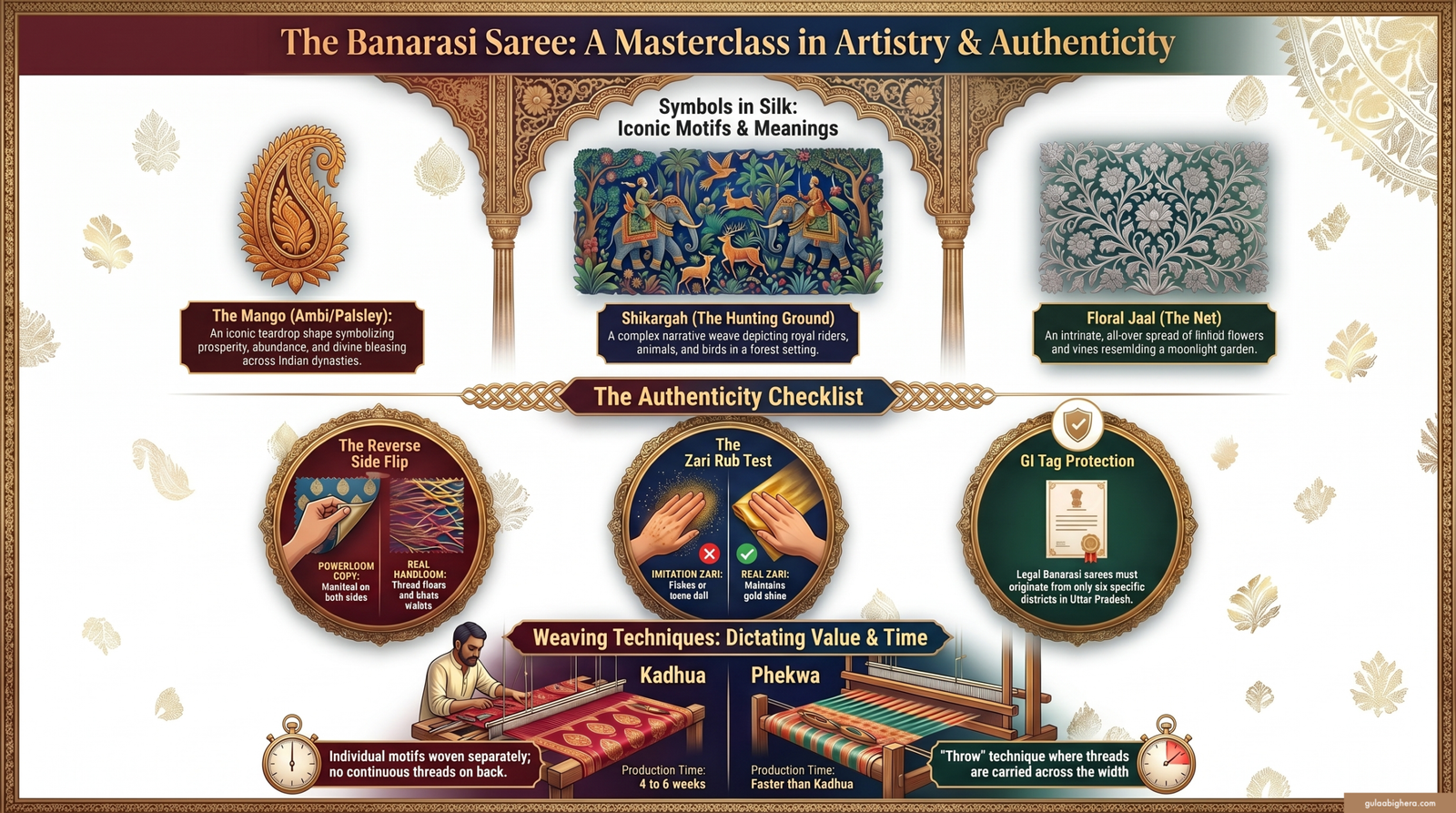
If you wish to verify the soul of a textile, you must look where the weaver did not expect your gaze: the back. Flipping the saree over is the ultimate “pro-tip” for authenticity, revealing the “human markers” that a machine cannot simulate.
- Thread Floats & Knots: On a genuine handloom Banarasi, the reverse is alive with activity. You will see thread floats (extra weft threads) running between motifs and small knots where the artisan tied off a color change. These asymmetries are the fingerprints of the craft. In contrast, a powerloom back is mathematically perfect, often as clean as the front.
- The Selvedge Pin Marks: Examine the edges, or the selvedge. Handloom pieces feature tiny, rhythmic puncture points. These are the marks of the pins used to secure the silk to the wooden loom during the arduous weaving process.
- The Border-to-Body Transition: Look closely at the line where the ornate border meets the main body of the saree. On a handloom, this transition will show tiny, charming irregularities. A machine-made copy will be mechanically straight and devoid of character.
In the lexicon of luxury, these “imperfections” are actually the highest marks of value; they prove that a human hand, not a circuit board, guided every thread.
3. Motifs as a Map of History: Painting with Thread
The designs on your saree are not mere decorations; they are a cultural DNA strand. The most iconic is the Mango Motif, a teardrop shape known variously as the Ambi, Kalka, or the original Persian Boteh. While it holds sacred status in Indian legends—associated with Ganesha and divine abundance—it reached its aesthetic peak through Mughal influence.
Beyond the paisley, two patterns define the Banarasi prestige:
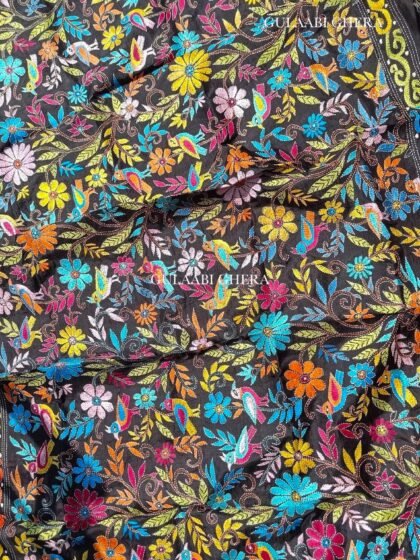
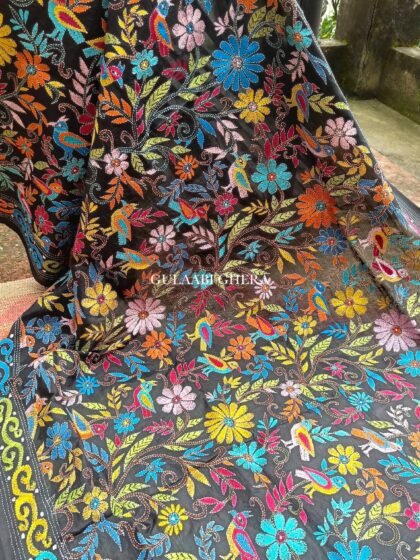
- The Floral Jaal: A sophisticated net-like spread of vines and blooms that creates a “garden under moonlight.” This pattern first appeared when Gujarati weavers settled in Varanasi in the early 1600s.
- The Shikargah: This “hunting scene” motif is essentially painting with thread. It depicts a narrative of royal riders, leaping deer, and soaring parrots. It is an imprint of old rituals and borrowed ideas turned uniquely Indian.
Whether through Meenakari (the use of colorful silk threads to add a “jeweled” effect) or Tanchoi (a satin-weave technique that uses no zari), these motifs represent what the Vasumatis sources call “Figured Muslin”—a legacy of royalty woven into every inch.
4. The “Kadhua” Labour Penalty
The price architecture of a Banarasi is dictated by the “labor penalty” of its technique. To understand the cost, you must distinguish between Kadhua and Phekwa.
- Kadhua: This is the pinnacle of weaving. Each motif is woven individually into the fabric, much like embroidery on the loom. Because there is no continuous thread thrown across the back, the motifs appear raised and the saree is exceptionally durable. A single Kadhua piece can take 15 days to six months to complete.
- The Kadhua Signature: Here is a secret only an expert would know: authentic Kadhua sarees often feature a 6–8 inch patch of plain silk on the pallu before the motif zone begins. Machines do not have a labor penalty, so powerloom copies will fill that space with motifs to appear “richer,” inadvertently exposing their mechanical origin.
- Phekwa: Also known as the “throw” technique, the motif thread is carried across the entire width of the saree and clipped. While beautiful, it is faster and more accessible.
5. Real Zari is a Precious Metal, Not a Color
In the world of the Banarasi, “gold” and “silver” are materials, not mere shades. Real zari consists of a fine silver wire flattened and wrapped around a silk core, then electroplated with pure gold. Imitation zari is simply polyester yarn coated with metallic film.
A Buyer’s Field Guide to Zari:
- The Gram-Weight Check: Sophisticated buyers always ask for the gram-weight (e.g., 3-gram or 5-gram zari). Higher weights indicate a denser concentration of precious metal, providing a “dignified glow” that catches light softly, rather than the “brash shine” of “Tested Zari” (a common industry euphemism for imitation).
- The Zari Rub Test: Rub a small section of the zari for ten seconds. Real zari maintains its luster; imitation zari will dull or reveal a greyish base as the polyester coating flakes.
- The Burn Test: Pull a single thread from a hidden seam and burn it. Real zari leaves a small grey ash. Imitation zari melts into a hard plastic bead and emits a sharp chemical smell.
6. North vs. South: The Banarasi-Kanjivaram Pivot
While both are titans of Indian silk, they are distinct architectures of fabric.
| Feature | Banarasi | Kanjivaram |
| Origin Influence | Mughal/Persian (Varanasi) | Temple Architecture (Kanchipuram) |
| Thread Structure | Fine, pliable silk threads | Thick, 3-ply Mulberry silk |
| Weight & Drape | Fluid, soft, and lighter | Firm, structured, and substantial |
| Zari Finish | Lies flat and shimmers softly | Stands out boldly and reflects sharply |
| Common Motifs | Floral vines (Jaal), Paisleys | Peacocks, Temple borders, Checks |
The Consultant’s Advice: Opt for the fluid Banarasi for evening receptions where movement and a “soft glow” are paramount. Choose the architectural Kanjivaram for formal temple rituals where a regal, structured silhouette is required.
7. The GI Tag: Why “Inspired” Isn’t Enough
In 2009, “Banaras Brocades and Saris” were granted Geographical Indication (GI) status. This legal protection ensures that “Banarasi” is a term reserved exclusively for sarees produced in six specific districts of Uttar Pradesh: Varanasi, Mirzapur, Chandauli, Bhadohi, Jaunpur, and Azamgarh.
When purchasing, look for two distinct labels:
- The Silk Mark: Certifies the purity of the silk fiber (Katan, Georgette, or Shattir).
- The Handloom Mark: Certifies the production method (the artisanal pit loom). A saree may be pure silk but made on a powerloom; only the Handloom Mark guarantees the survival of the weaver’s heritage.
8. The Muslin Rule: Preservation for Generations
To maintain an heirloom, one must combat “silk memory”—the permanent creases that can weaken fibers over time.
- Storage: Wrap your saree in soft muslin or cotton cloth. Forbid plastic covers, as they trap moisture and cause the precious zari to oxidize and blacken.
- Movement: Every few months, unfold the saree to air it in a shaded spot and change the folding pattern.
- The Consultant’s Secret: Place dried neem leaves or silica gel packs in the storage area to naturally repel insects and control humidity.
- Avoidance: Never spray perfume directly on the silk (the alcohol stains) and strictly avoid machine washing. Dry cleaning is the only way to preserve the metallic luster.
9. Conclusion: A Garden Under Moonlight
To wear an authentic Banarasi is to drape oneself in a “garden under moonlight”—a shimmering landscape of Tilfi and Meenakari work that feels as relevant today as it did in the Mughal courts. Behind every six yards of silk are the “thousand hearts” of history and the “hundred hands” of the artisans who still work the pit looms of Banaras.
The next time you drape this silk, ask yourself: are you merely wearing a fashion statement, or are you participating in a century-old conversation? In twenty years, will your saree be a forgotten garment, or a legacy you pass down with a story?